Disclaimer: This article is based on research and insights from credible medical professionals, publications, and institutions. It is intended for educational purposes only and is not a substitute for professional diagnosis or treatment. If you believe you may be experiencing symptoms of bipolar disorder, please consult a qualified healthcare provider.
BIPOC (Black, Indigenous, and People of Color) experience bipolar disorder at the same rate as other Americans, with an estimated 2.3 million people living with the condition. However, Black Americans and other marginalized communities face significant barriers to proper diagnosis and treatment, impacting their lives and families for years to come (Mental Health America, n.d.). Understanding the differences between bipolar I and bipolar II is a crucial first step in educating yourself about this complex mental health condition.
While it may seem overwhelming, Ebony Emotions is here to help clarify these distinctions and provide insight into the different types of bipolar disorder. According to Healthline, there are four types of bipolar disorder: bipolar I, bipolar II, cyclothymic disorder (cyclothymia), and other related disorders (Roland, 2023). Each type presents unique challenges, but the primary difference between bipolar I and bipolar II lies in the severity of manic episodes.
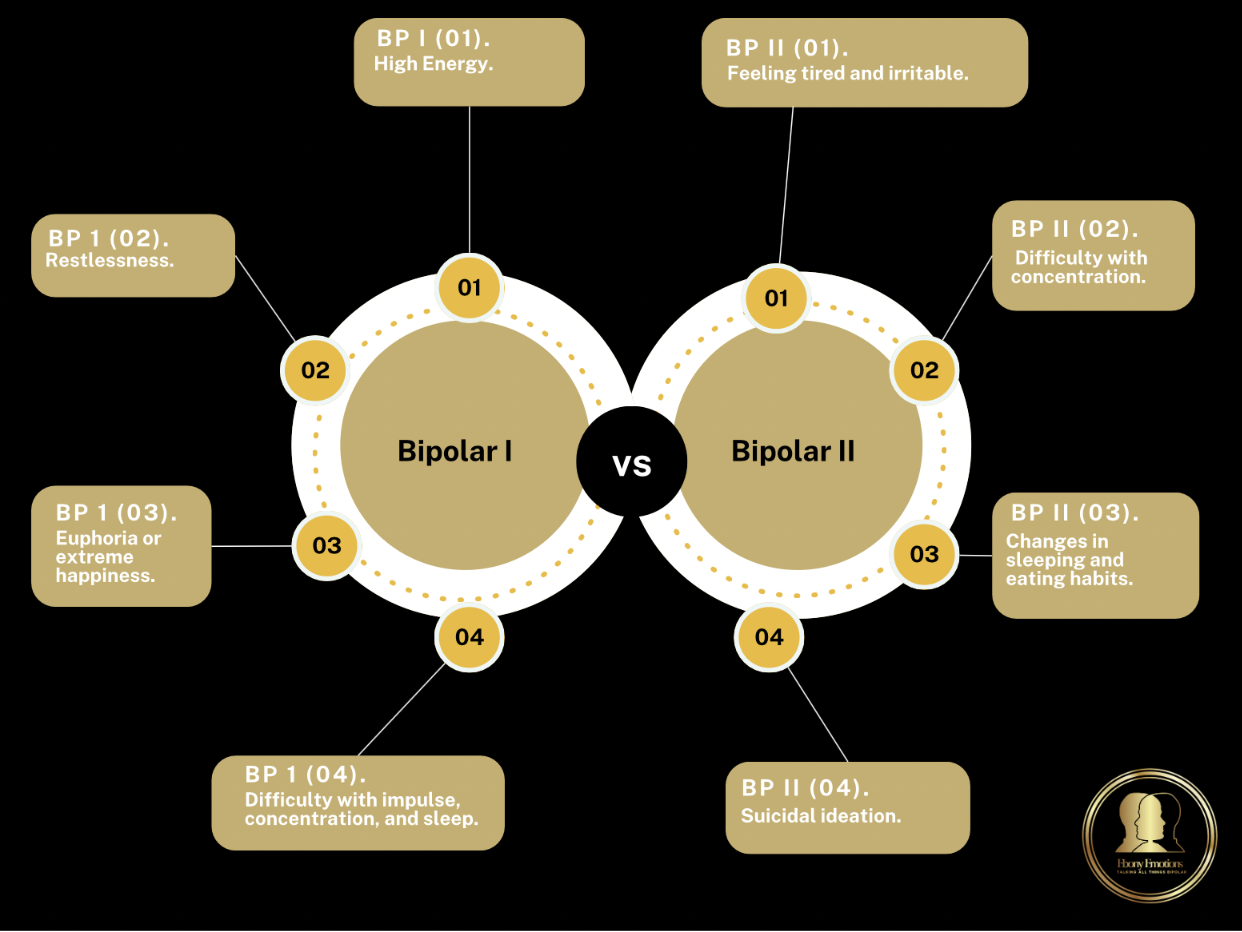
Bipolar I: Full Mania
Individuals with bipolar I experience full manic episodes, which can require hospitalization due to extreme mood changes and risky behaviors. Symptoms of mania include:
-
Excessive energy and restlessness
-
Difficulty concentrating
-
Extreme happiness
-
Impulsive behaviors with potential consequences
-
Decreased need for sleep
Research by Julie A. Fast and John Preston, authors of Take Charge of Bipolar Disorder, suggests that episodes of depression (common in bipolar II) or mania typically last from several weeks to several months before subsiding. Individuals with bipolar I usually return to their baseline and feel and act “normal” between episodes. Months or even years may pass without major changes in mood, but eventually, another episode will reemerge (Fast & Preston, 2023).
Bipolar II: Hypomania + Depression
In contrast, bipolar II involves hypomanic episodes, which are less severe than full mania but still affect daily life. The key characteristic of bipolar II is that it includes major depressive episodes, which can last up to two weeks. Due to this, bipolar II is often misdiagnosed as depression. Signs of depression may include:
-
Persistent fatigue or irritability
-
Difficulty focusing or making decisions
-
Sleep and appetite changes
-
Feelings of hopelessness
-
Suicidal thoughts